


Reading
#ClassicandContemporary book challenge: November
#ClassicandContemporary book challenge:
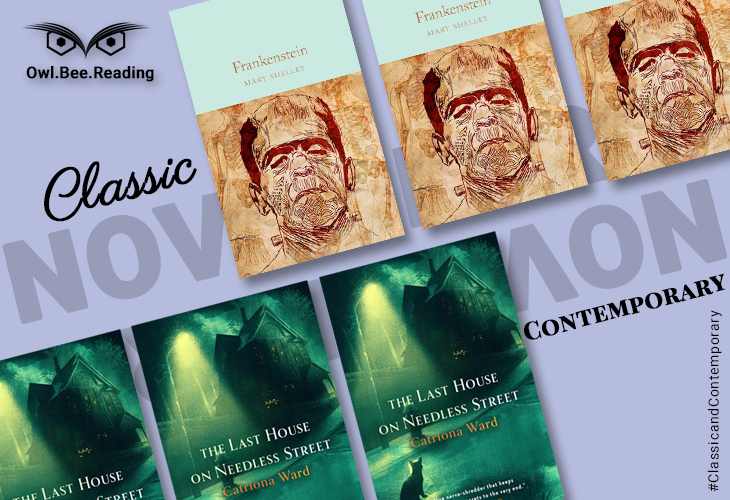
Frankenstein and The Last House on Needless Street
The Last House on Needless Street
Author: Catriona Ward
Genre: Thriller, Mystery, Horror
Publisher: Profile Books
Year: March 2021
Rating: 
Where do I even start with describing this book? It’s one of the most brilliant and unsettling horror reads I’ve stumbled upon in my entire reading journey. I love how clever it is, how brilliantly disorienting and deeply compassionate and strange… I also admire the delicate way the author deals with the main theme (content warning: mental illness). I could pick it up many times and I’m certain I’ll find something different with every re-read.
I don’t want to talk too much about this book, as I don’t want to spoil anything from the plot for you, so you’ll have to trust me on this one: just read it!!! I can’t remember how I found it, or how it found me, but it is one of those rare novels that manages to be terrifying, tender and disarming all at once. It’s addictive and once you begin realising where it’s heading, you won’t be able to stop reading or thinking about it. It starts as a classic psychological horror (an isolated man in a boarded-up house, a missing kid, a suspicious neighbour, a cat who is partly the narrator) and then suddenly destroys every assumption you think you’ve made.
There are several ways in which you think the story may unfold. It looks like a serial-killer thriller. Then it feels like a haunted-house story. Then it becomes something far more intimate and surprising. Catriona Ward plays with genre expectations the way a magician plays with cards, you know you are closely reading every word but you are still fooled. What I liked about her writing was that The Last House on Needless Street was not a book that relied on jump scares or gore. Its horror comes from fractured memories, unreliable narrators, the claustrophobia of trauma and the uncanny sense that something is off in every scene. Yet, beneath all that darkness, the novel is deeply empathetic. The author has taken a difficult, sad subject, and turned it into something really beautiful and emotionally resonant in a very respectful and engaging way, which is rare in horror fiction. Her prose is eerie and lyrical, and the pacing is set just right: she knows exactly when to linger and when to pull back.
There are so many plot twists and unexpected things happening. Each perspective is a piece of the puzzle that makes sense once you see the full picture. The final reveal is both shocking and strangely healing, the kind of twist that forces you to trace your steps back and rethink every chapter. The characters grow on you as the plot advances and, I promise you, you’ll change your mind about them several times. The setting is a character in itself: a decaying house at the edge of the woods, full of locked rooms, boarded windows and secrets. The eeriness is always there, present in every chapter, so this is a perfect cosy read for these months of the year. Plus, there are cats, what more would you need? 🐈⬛
This book is undoubtedly one of my top five reads this year, and ever, with a five-star rating!
Frankenstein
(mini review)
Author: Mary Shelley
Genre: Science Fiction, Gothic, Horror
Publisher: Lackington, Hughes, Harding, Mavor & Jones
Year: January 1818
Rating: 
My November classic book pick for the reading challenge is Frankenstein by Mary Shelley. To be fair, once I started it, I didn’t look forward to reading it, as I wasn’t invested enough in the story. I could see why it is a classic, as the themes it explores are universal, and that makes the book ever relevant to our reality. But the way it was written didn’t really grab me, especially the long dialogues-turned-into-monologues parts. However, the nature scenes were beautifully described: dramatic landscapes, icy wastes, stormy nights, shadowed forests. I really enjoyed this depiction of Edinburgh in particular:
I visited Edinburgh with languid eyes and mind; and yet that city might have interested the most unfortunate being. Clerval did not like it so well as Oxford: for the antiquity of the latter city was more pleasing to him. But the beauty and regularity of the new town of Edinburgh, its romantic castle, and its environs, the most delightful in the world, Arthur’s Seat, St Bernard’s Well, and the Pentland Hills, compensated him for the change, and filled him with cheerfulness and admiration.
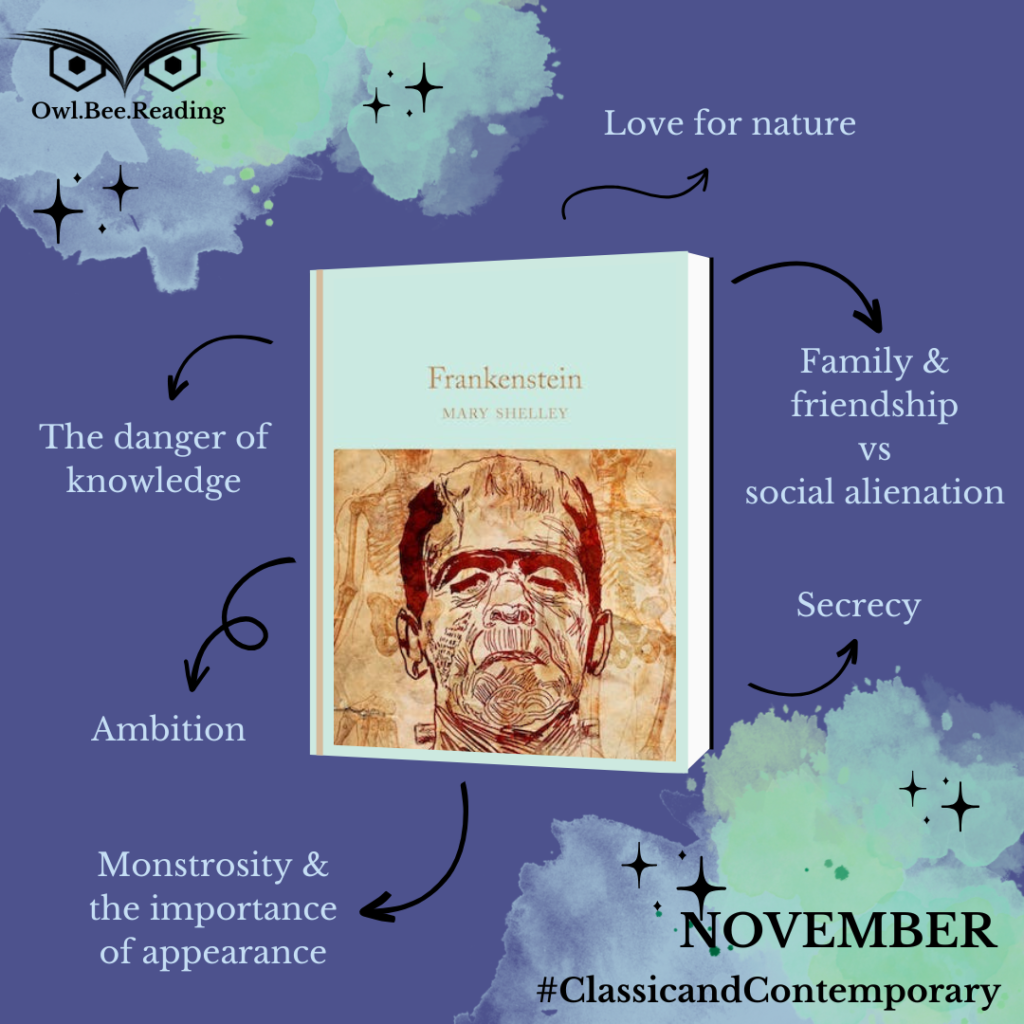
I had to keep reminding myself that the novel is not just a gothic horror story, it is also a philosophical tragedy about creation, responsibility and what it means to be human. Scientific ambition is at its centre but even more so the theme of emotional failure. Victor Frankenstein creates life, then immediately recoils from it, and that single act of abandonment becomes the novel’s true horror. His failure, or rather refusal, to connect with the monster he created led him to hide from his fears instead of facing them. On the other hand, the monster is depicted not as a villain, but as a mirror. Every time the creature becomes violent, it is in response to loneliness, rejection and Victor’s failure to understand it or his refusal to acknowledge his own responsibility. So you may ask yourself, who is the real monster?
There is another layer that I find quite interesting, the fact that Shelley understood that monsters are made, not born. Frankenstein unapologetically shows us that cruelty is learned, it is not innate. The creature begins its life as a gentle and curious being, ready to explore and learn, but its reality and the world teach him differently – rage, revenge, causing disaster. Frankenstein remains relevant because it delves deeper into the anxieties of today’s world: technological advances but at what cost, failure to empathise and relate to other people’s experiences, social rejection (called “cancelling” today), the fear of being unloved, worse even, unlovable. As a horror novel, its deepest terror is emotional rather than physical.
In the end, I’m glad I re-read it with a fresh perspective to see why the novel is foundational not just to horror, but to science fiction, philosophy and modern discussions about identity and the acceptance of those who are different. I felt sad for the poor monster – it simply needed to be loved and understood without everyone centering on his appearance. The creature’s plea “I am malicious because I am miserable” is one of the most devastating lines in literature, in my opinion. 🧟
In case you need me… #owlbeereading!


