


Reading
#ClassicandContemporary book challenge: September
#ClassicandContemporary book challenge:
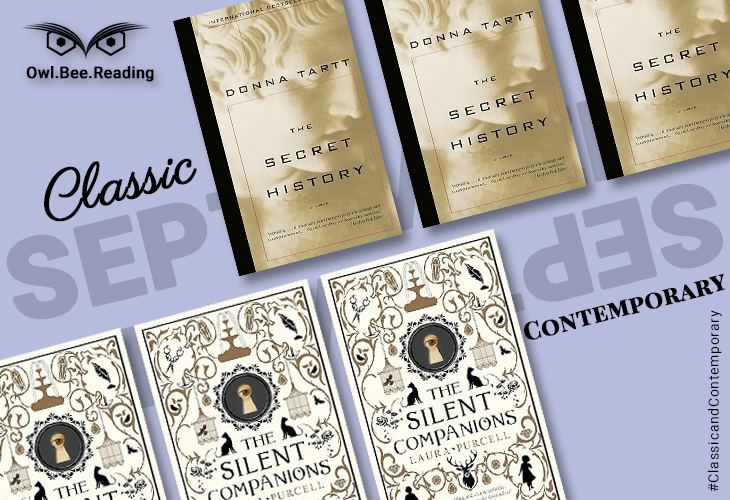
The Secret History and The Silent Companions
The Silent Companions
Author: Laura Purcell
Genre: Horror, Historical Fiction, Gothic, Mystery
Publisher: Bloomsbury Publishing
Year: October 2017
Rating: 
This book is what you need to get if you are looking for an atmospheric read! A dark Victorian tale, it is spooky and mysterious and quite intense. Let me start with the synopsis first.
When newly widowed Elsie is sent to see out her pregnancy at her late husband’s crumbling country estate, The Bridge, what greets her is far from the life of wealth and privilege she was expecting…
When Elsie married handsome young heir Rupert Bainbridge, she believed she was destined for a life of luxury. But with her husband dead just weeks after their marriage, her new servants resentful, and the local villagers actively hostile, Elsie has only her husband’s awkward cousin for company. Or so she thinks. Inside her new home lies a locked door, beyond which is a painted wooden figure—a silent companion —that bears a striking resemblance to Elsie herself. The residents of The Bridge are terrified of the figure, but Elsie tries to shrug this off as simple superstition–that is, until she notices the figure’s eyes following her.
A Victorian ghost story that evokes a most unsettling kind of fear, this is a tale that creeps its way through the consciousness in ways you least expect–much like the silent companions themselves.
Set in 1866, this gothic horror novel will fill your days and nights with ghosts. Some of the scenes were really creepy, which is why it was the perfect read to give an early start of the spooky season. As the blurb says, the story follows the misfortunes of Elsie Bainbridge, a young woman who moves into her late husband’s eerie country estate and is forced to live with her husband’s cousin in a house full of evil servants and secrets lurking within its walls. I really liked the main heroine, she is intelligent and opinionated, but in a good way, determined to live her life at her own terms.
The novel is structured across multiple timelines, so we first meet her in the present moment, when she has clearly suffered a trauma and has been asked by her doctor at an asylum to write about her struggles, while waiting to be hanged for her crimes. From her writings we understand how she got into that situation and what she had to endure. The several storylines reveal things from the present and the past simultaneously, and the chapters alternate the events, so it is up to the reader to organise it all chronologically in their head. On top of that, Elsie finds Anne Bainbridge’s diary, a 17th-century ancestor’s haunting entries which include an early description of the horrors this house holds. Just to make the whole story even more unnerving.
Elsie chooses to stay in her husband’s estate, in that creepy old mansion full of secrets. Like in every ghost story, you shouldn’t go looking for skeletons in the closets unless you are ready to face what’s inside. As the story progresses, Elsie finds it more and more disturbing to keep living in that old house and keeps unravelling things from the past. There are deep secrets buried beneath the appearance of a wealthy and kind but a little peculiar family. The servants soon start to act weird around her and she has this uneasy feeling about the house. Horrible things start to happen and Elsie soon finds the connection between the silent companions, creepy haunted wooden paintings of the previous inhabitants of the house, and the strange events. At this point in the story, you begin to appreciate Purcell’s mastery of blending historical fiction with supernatural psychological suspense moments. I will leave you to uncover the rest…
The writing is immersive, atmospheric and evokes a feeling of creeping dread that builds up throughout the novel. The slow-burning suspense and the unnerving presence of the companions, silently watching Elsie’s every move, make for a truly disturbing read and an eerie experience that will keep you awake for a long time at night.
I genuinely enjoyed this book and would recommend it to anyone seeking a slow-tension building story, a creepy tale featuring weird and evil house objects.
The Secret History
((not-so-)mini review)
Author: Donna Tartt
Genre: Dark Academia, Mystery, Literary Fiction
Publisher: Penguin Books
Year: September 1992
Rating:
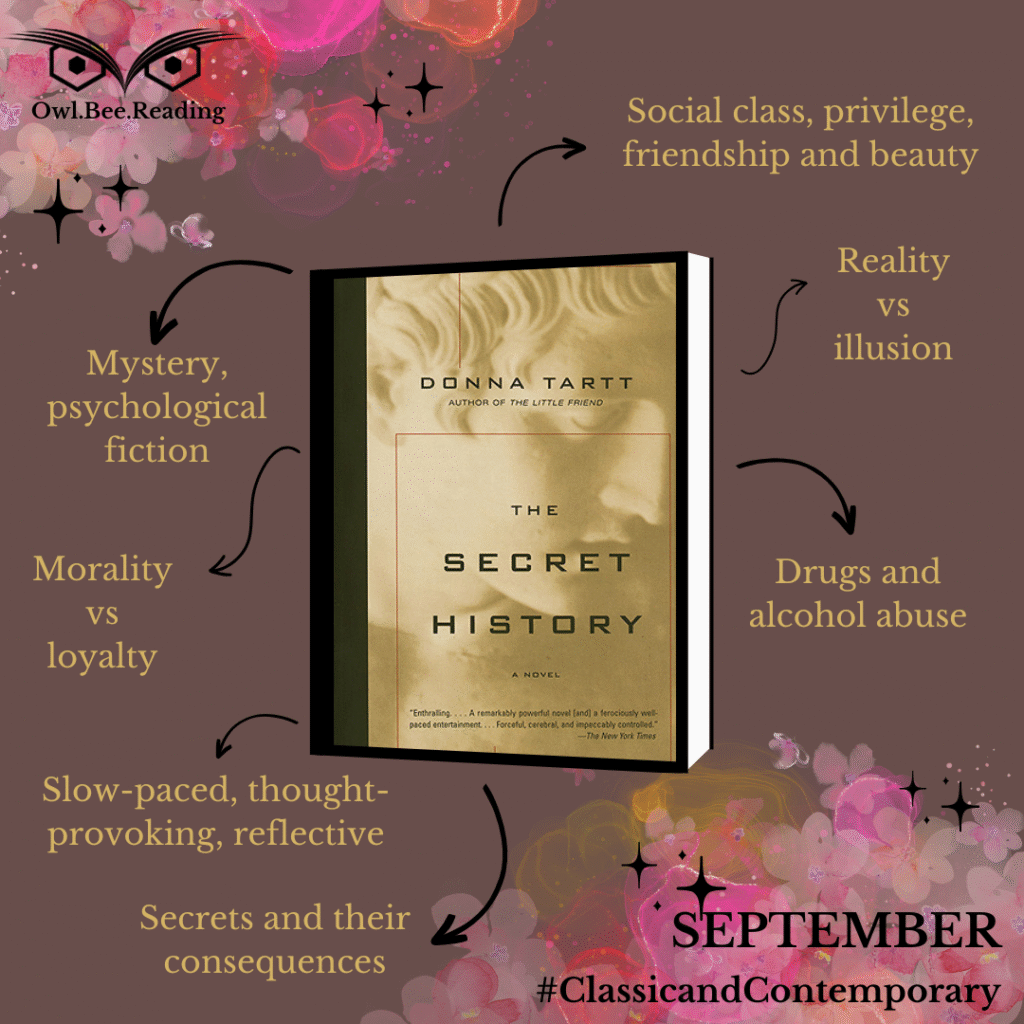
Having finally read The Secret History, I truly believe it is a book that everyone (interested in dark academia vibes) should read. It’s a combination of a thriller and mystery, and has psychological elements, combined with classical tragedy, all happening in a dark academic setting.
The story follows a group of students, an elitist and eccentric bunch of young people, studying Greek in a New England college. Their interest and dedication to the subject take a different turn than the pure academic pursuit of achievements and intellectual success. They take on a dangerous path and, gradually, their friendship starts to depend on their loyalty to each other – are the people who say are your friends truly got your back no matter what?
Some of the themes the book explores are beauty, morality, connections and social status, obsession. Privilege and self-destruction by never having one’s needs satisfied, not even knowing what those needs are, are also central topics. The characters prove to be self-sufficient but their increasing need to be alone, or to form secret groups of two or three, is becoming disturbing, as it turns out. What I enjoyed about the characters was that they are all flawed but that doesn’t take away of their charm. This makes the novel true to real life and shows the “greyness” of people – nobody is only black or only white. The secretiveness and the selectivity in choosing whom to trust or to include in the group is another huge thing and it only adds to the feeling of elitism, exclusivity of the upper class and being among the “chosen ones”.
What surprised me was the amount of guilt these characters felt, as I didn’t imagine them as people who would have any second thoughts or regrets about their actions, let alone having to face the consequences. But the more we dive into this seductive world, the more dangerous and ominous it becomes. The recklessness of the privileged makes the moral collapse even more compelling. Being rich and the belief that you are something more because of that deceives them that the consequences don’t matter for them, that their actions would have no real repercussions and that they are somehow protected. As the story progresses and their lives unravel, this illusion of being immune is shattered, demonstrating that privilege can delay – but not erase – accountability.
Compared to most crime books, The Secret History is different in terms of structure: the novel starts with a revelation and then retraces the events leading up to it, which creates a sense of inevitability and suspense. As the actual mystery is revealed early on, the rest of the book is dedicated to show us the true nature and psychological nuances of the characters.
Donna Tartt writes beautifully, her way of choosing the right words for every situation makes the prose so rich and atmospheric, nostalgic and lyrical. The book feels almost like a dream, its characters improbable and the events surreal. This combines really well with the classical literature and philosophical musings. The atmosphere that Tartt creates is unmatched, very detailed and filled with classical references that lend the story its timelessness and otherworldliness, almost.
I believe that, in the end, the things that drive the characters to their downfall are the pursuit of beauty, in the sense of justifying their behaviour by having unattainable standards and acting in the name of higher ideals, the feeling of intellectual superiority, which sets them apart from “ordinary students” and, finally, isolation. We see that more modest backgrounds are seen as too different, unable to be included in the world of wealth and exclusivity, and the outsiders, students such as the narrator, Richard Papen, are desperate to fit in. This sense of alienation drives his decisions for the most part and adds even more misfortune to the story.
It is a very complex and layered novel of exploration of the human nature and the need to belong – to a social group, to an academic environment, to a final cause, and of the lengths the participants are ready to reach in order to achieve it. Richard’s initial desire to be part of the group subsides into guilt which eventually leaves him hesitant about the morality of his friends’ actions and shakes his idealised version of them. The leader, Henry Winter, is the embodiments of morality and corruption. He tries to control the group’s decisions but that only leads to paranoia and a tragic fate.
The seemingly carefree lives of the rest of the characters, Francis Abernathy, the twins Camilla and Charles Macaulay, and Bunny Corcoran, are marked by deep isolation, misunderstandings, obsession with aestheticism and apparent decency, which ultimately lead to anxiety, fear, moral decay and dysfunction. As the group’s carefully curated world gradually descends into instability, they show us that sometimes what people show on the surface has nothing to do with their real nature. Nothing is what it seems and nothing is as good and perfect as it seems.
On that positive note, I am leaving you for now, because this review became too long, and will meet you in the next blog post! 📝
In case you need me… #owlbeereading!


